Physical Address
Santasi Roundabout.
Off - Obuasi Road, +233 245628894
Physical Address
Santasi Roundabout.
Off - Obuasi Road, +233 245628894

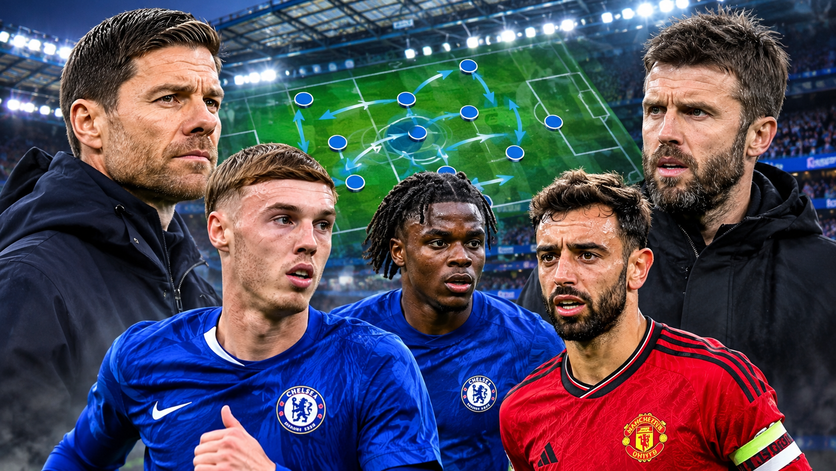
For more than 50 minutes, Chelsea versus Man United was one of the most entertaining matches of the season, but entertaining in a way that showed the good in both teams, and more importantly, emphasised their tactical weaknesses.
In this article, we’re going to take a look at the tactics in that first hour or so, because that’s where we truly learned how both of these teams actually operate and where each of them was vulnerable. Chelsea operated with a hybrid formation that, when they were in possession, was a 4-2-3-1, and we’ll circle back later in this article to how this changed when they did not have the ball.
United’s defensive shape was clear throughout, though, with the attacking midfielder looking to join in. And on paper, there were advantages to the shape for Carrick. Chelsea’s in-possession back four were aggressive, and depending on which side the ball was, Acheampong or Pellistri would push higher.
So what were the potential advantages for United of defending in a 442 against the shape? Well, the front two could choose to immediately apply pressure on both centre backs, which we saw at times.
Or if United were looking to be a bit more conservative, the front two would sit on the double pivots, allowing their own midfield to focus on closing the gaps between the lines. But football is always dynamic, and Chelsea were using their movements to undo the United shape. And the first key to this was Caicedo, who consistently was looking to move into this space early on.
Firstly, it gave Chelsea a three versus two advantage when United did press, giving them an easy outlet. But maybe even more important was its secondary impact. United focused on Caicedo’s initial movement to protect the centre as much as possible, but this movement could draw Amad out of his defensive position, creating space both centrally and wide.
And the wide region was particularly interesting. Pellistri could receive, and because Diallo was high, to prevent a potential two versus one down the flanks, either a centre back or a midfielder would have to come across, which could begin to destabilise the defensive shape. But here’s the reality, because what do you see here? Chelsea rarely attacked down their left-hand side, and the reason that they attacked down the right most is the centre.
See, Chelsea were really looking to overload the middle of the pitch as much as possible. The right winger tended to stay wide, but Morgan Rogers’ average position was very narrow. The reason Pellistri was so aggressive down the left was to allow Rogers to push infield as early as possible. And it wasn’t just that. The Chelsea front three tended to rotate, but whoever found themselves at centre forward was also willing to come deeper.
So Chelsea could actually pack out the centre of the pitch, increasing the odds of completely overloading United’s double pivot midfield. At times, United were struggling to handle the situation. Rogers’ movements had to be addressed to stop that overload.
And what that often meant is Maguire at the right centre back was being forced to push higher up the pitch in order to prevent this. And for the most part today, he actually handled it all right. But having your most immobile centre back, tracking a tricky winger who could turn him, and at the same time having that centre back not have the recovery pace to track back is not an ideal scenario.
United were probably going to be defending narrower in a 442 anyway, but Chelsea having this much central presence forced them to defend even more narrowly. And Chelsea looked to use that fact against United.
Cunha especially could be caught not only defending narrow but also higher up on occasion, meaning that Acheampong would have acres of space out wide, and Chelsea could look to find him and then manufacture an overload or get a united midfielder to come across on the cover, which would then create more room in the centre of the pitch for their men to look to exploit.
Cole Palmer, attacking midfielder on paper in 4231, spent almost all his time on the right-hand side. And that’s because United, by protecting the centre, had opened up the flanks for attack, and Palmer was key to this.
With Estêvão hugging the touchline down the right-hand side, Dalot could be pinned wide and deep. And especially if Cunha was narrow, Palmer could receive the ball and then advance up the pitch. And even if Cunha was defending a little wider, Acheampong bombed down the flank for most of the match. So Chelsea still had the potential of creating three versus twos on this side of the pitch, which is why they were so determined to attack down this flank.
But let’s be extremely clear about one thing. It wasn’t a perfect in-possession plan because when Caicedo was operating more like a traditional midfielder and both fallbacks had pushed high, it meant that they only had a back two in the buildup.
So every time they lost the ball, there were huge spaces for United to hit on the transition, which they did consistently. The only reason United weren’t even more dangerous on the break is they spent so much time defending in a deep 442 when Chelsea advanced, meaning that there were large distances to get into these zones behind the fallbacks for United on the break.
Remember that 4-2-3-1 we said Chelsea had in possession? Well, it was very different when they were defending. Higher up the pitch, it would look closer to a 4-4-2, with Palmer tucked in alongside the forward, while Estebal also tucked in. But United’s attacking shape forced Chelsea to change how they’re defending deeper on the pitch.
Dalot played a similar role to Pellistri, providing all the width so that Cunha could drift infield centrally alongside Fernandez. What it meant is that as the fullback advanced, Estêvão would be forced to track him and drop deeper into a pseudo back five so that the shape was effectively an extremely lopsided 5’3″. And Chelsea could afford to be this lopsided because United did not have anybody looking to take advantage of these vacated spaces.
So in the deeper shape, Palmer was defending narrower, and this would often cut the passing lane into a midfielder, aligning their deeper pivots to deal with the drifting Cunha. But where United had the most success was their right flank. When United attacked like this, Chelsea did not have too many problems. Rogers would watch Yoro, and Pellistri would track Amad Diallo, but it would not be long before United figured out how to get at Chelsea like so many other teams have this season.
When Diallo received the ball, Pellistri would naturally look to apply maximal pressure on the winger. But if, rather than being conservative, Yoro made the run high up the pitch, either underlapping or overlapping, he could get into dangerous positions because Rogers would be unlikely to track back consistently.
Or we could see Diallo or a different United man work their way into the half space to receive. But maybe United got too aggressive with this strategy because it actually led to Chelsea’s opener.
Yoro is looking to push high immediately, while Rogers is high to get the instant overload. But a possession loss means there’s now space where Yoro would’ve been had he been more conservative, which is why Maguire has to cover the wide pass and also watch Rogers, which eventually allows the Englishman to walk straight through the defence.
This was undoubtedly a fun match, but it also showed just how far Chelsea have to go if they are to fulfil all their ambitions at the very highest level. But what did you make of it? Let’s hear from you in the comments section.
Join our channels for the latest sports news, live updates, and more:
✅ WhatsApp 📢 Telegram